Ceren Eliaçık — 19.05.2026 — All rights reserved
Armand Henrion (1875 – 1958) – Le Rire (1930)
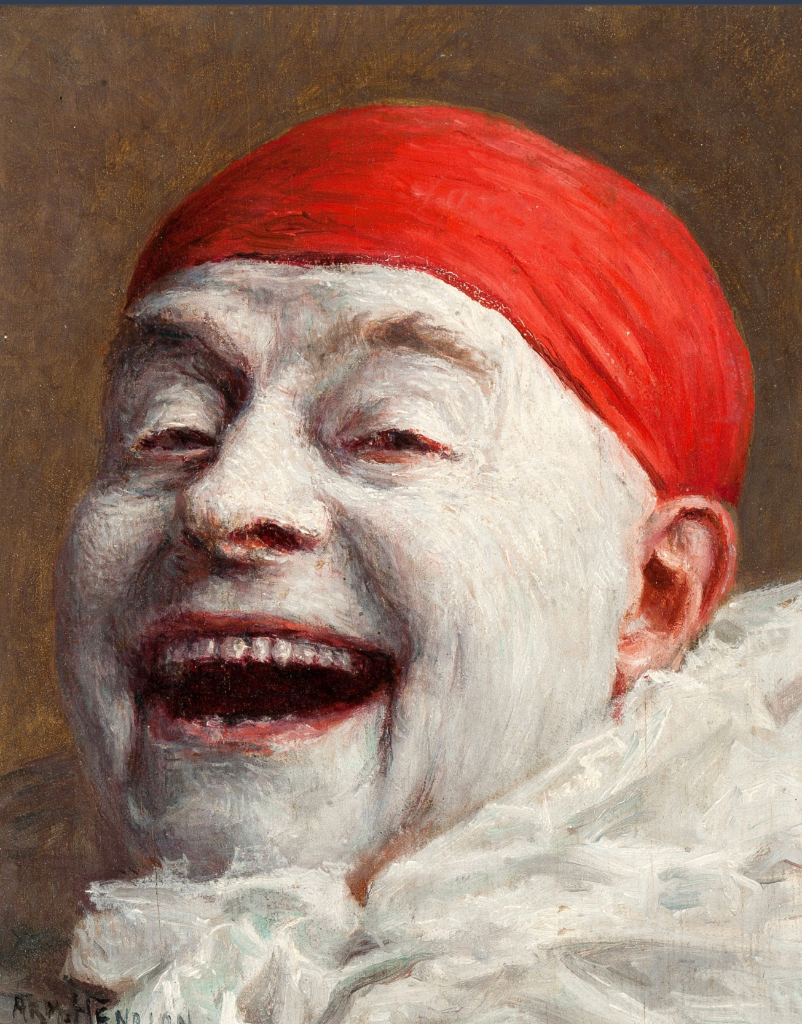
Armand Henrion – Le Rire (1930)
Armand Henrion dedicated nearly his entire career to a single subject: painting himself dressed as a Pierrot clown.
Objective Description
Le Rire is a small-scale oil painting, typical of Henrion's realist style.
-We can see the self-portrait of the artist in the guise of a Pierrot. The figure is positioned centrally against a dark, minimalist, and non-descript background, which forces the viewer's focus entirely onto the person and his facial expression.
-The artist wears a traditional white, loose-fitting Pierrot tunic with an exaggerated neck detail, complemented by a vivid red skullcap (calotte). The face is covered in a thick white base. The eyebrows are exaggeratedly arched in brown, and the lips are painted a vivid, saturated red. When it comes to technique, Henrion uses fine brushwork with a focus on the texture of the makeup—you can almost see the "caking" of the white paint on the skin. His neck and ears reveal his natural skin color, contrasting with the white paint: consequently it looks like a white mask. The mask is on his face but feels totally independent from himself.
Subjective Interpretation
- While we observe this art piece entitled, "The Laugh," we might feel disturbed. The white makeup feels like a "mask," the laughter looks performative rather than a spontaneous emotion, almost looking robotic/insincere. Even though it is an innocent-looking painting representing a laughing clown, it makes us feel as though he is hiding something...
Why did I choose this painting ?
-Henrion shows how the Persona (the Pierrot-clown*) can eventually dominate the individual. By the end of his life, his identity as an artist was inseparable from his identity as a clown.
-The Subjectivity of "Seeing": "seeing is interpreting." When we look at Le Rire, we don't focus on the happiness of a man ; we see a clown laughing-It's almost like we separate these two concepts 'human' X 'clown'. A human dressed as a clown almost loses his identity as a 'human' but becomes something different ; a clown. The makeup changes our empathy- we interpret both characters differently. The reason is simple, when we see a 'natural' looking person who is dressed in neutral clothes and doesn't wear any make-up that changes the human features; we tend to think, why is he happy ? When we see a clown smiling, looking joyful we don't question that- because a clown is supposed to be happy, it's a part of his job. But why do we predominantly think that way ? Maybe our thoughts are not 'as individual' as we think- could be because of the fact that we also learn how to interpret things socially, which leads us to have "collective opinions"…
I. The clown
The Linguistic Root
→Source Language- Primarily Low German and Scandinavian.
The original word is related to the North Frisian klönne (clumsy person) and Icelandic klunni (a boor or clumsy fellow). It entered the English language in the 1560s. Originally, it did not mean a performer; it was a derogatory term for a "rustic, peasant, or boor." The "clown" was the country person who lacked the "sophistication" of the city, hence their association with physical clumsiness and social ignorance. Although historically the approach that our ancestors had, was different from how we represent and think of them contemporarily…
Origin & Short History
→The Ancient Ritual Role (2400 BCE – 1400 CE)
In ancient cultures like Ancient Egypt, China, and Greece, the "clown" was often a sacred figure. For example, the Chou in Chinese Opera was meant to bridge the gap between humans and gods by showing the absurdity of life.
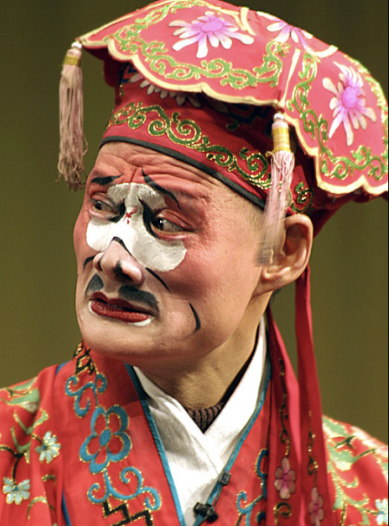
The "Chou" in Chinese Opera
→The Renaissance & The "Fictional" Clown (1500 – 1700)
In Italy and England this concept evolved in an artistic direction during the 16th century. The Italian Commedia dell'arte (1550s) was the first time "clowning" became a codified, professional theatrical practice. These troupes used stock characters who were essentially clowns (Arlecchino, Pulcinella, Pierrot). This was the first professional theater where actors were paid specifically to maintain a "clown persona" across different plays.
In England, William Shakespeare and his contemporaries integrated the clown directly into the structure of the play. Before this, "fools" often did their own acts separately. Shakespeare hired professional clowns like Will Kemp and Robert Armin to play specific roles (The Gravedigger, The Fool in King Lear). This moved the clown from a "side-show" to an essential narrative 'tool' that offered social commentary.
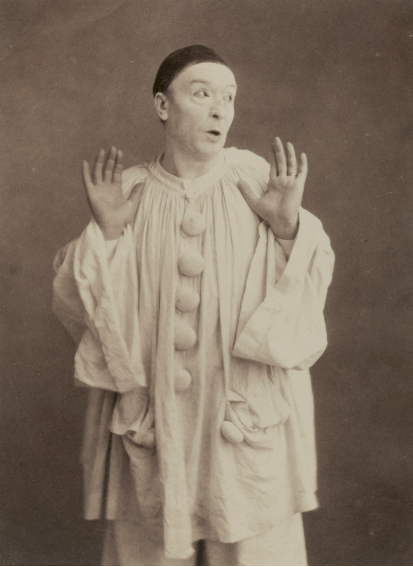
-"Pierrot" the clown
→The Modern "Joey" (1768 – Present)
The turning point that changed the destiny of the clown character, coincided with the creation of the first circus ring in 1768 by Philip Astley who needed someone to fill time between horse acts.
The Icon of the circus during that phase was Joseph Grimaldi (1800s) known as the "Father of Modern Clowning." He was the first to use white face paint and colorful, oversized clothing, consequently laying the foundations of today's visual look. This transformation was certainly remarkable; the clown character became a visual spectacle in a circus.
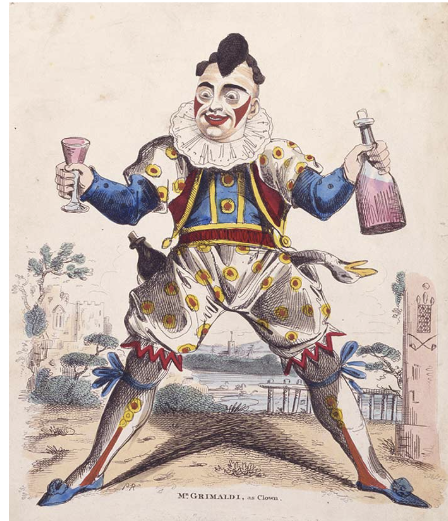
Joseph Grimaldi as "Clown Joey"
We might also study the fact that clowns were a permanent and vital fixture in royal courts throughout the Middle Ages and the Renaissance. We especially tend to make a connection between 'stupidity' and clowns. However the term "fool" / "Stupid" is a historical misnomer; these individuals were often among the most clever, politically savvy, and observant members of the royal household.
Were they really "Fools"?
In the "royal space," they were generally known as Court Jesters.
The word "fool" did not necessarily mean "stupid." In the royal context, there were two distinct categories of jesters:
-The "Innocent Fools" were individuals with actual mental or physical disabilities. In a time before modern social services, they were brought into the court to be "cared for," though they were often cruelly used as objects of amusement. It was believed their "madness" gave them a direct line to God.
-Conversely the "Artificial Fool" were professional clowns. These were highly educated men—philosophers, musicians, and linguists—who performed the role of a fool.
Their Exact Roles in the Castle
Their job description went far beyond "making the King laugh." They served several critical functions.
The "Truth-Teller"
According to history the fool's primary role was to tell the King the things his advisors were too afraid to say. If a King was losing a war or making a greedy law, the Jester would mock these decisions through a joke. This allowed the King to hear criticism without losing face.
The Advisor and Mediator
Jesters were often the King's most trusted confidants because, unlike dukes or counts, the jester had no land, no army, and no claim to the throne. He was not a political threat.
The Stress-Reliever
Castles were high-tension environments filled with paranoia and assassination plots. The jester's role was to break that tension. → *Political Tools: Sometimes a King would use his jester to insult a visiting rival. If the rival got angry, the King would simply say, "Ignore him, he is just a fool," while the message was clearly delivered.
Why do we still talk about clowns today ?
In the past the clown was considered as a social mirror. They were allowed to say things no one else could, benefitting from the privilege of their status. Anthropologically in many Indigenous and ancient cultures, clowning was a religious duty used to keep society honest. The Heyoka in Lakota culture (the Lakota are a native American people) is a "contrary" clown who does everything in reverse. They are considered "sacred" because their behavior forces the tribe to question the "correct" way of doing things. Anthropologists like Julian Steward and Franz Boas documented how North American "Clown Societies" would parody the tribal chiefs during sacred ceremonies. If a chief became too greedy or arrogant, the clowns would mimic him publicly to shame him back into humility.
Besides the historical and anthropological dimensions, literature is also a highly valuable domain for recording social roles. William Shakespeare's characters provide the best evidence of the clown's role as a mirror. The Fool in the tragedy 'King Lear' is the only character who speaks the truth about the King's descent into madness. Lear calls him his "all-licensed fool." Shakespeare used the clown to provide a subversive critique; since the character was "low-born" and "unserious," the audience could hear radical political ideas without the play being censored by the state.
Despite the makeup and the clown persona that he hides behind, the clown is often more "human" than the human behind it. This is the great paradox of the art form...
The Mirror Effect
The clown is an amplification of the human's specific ridiculousness. A teacher who is a clown will be a caricature of authority; a shy person who is a clown will be a caricature of invisibility. The clown cannot exist without the human's authentic traits to feed on.
The Shared Vulnerability
Both the human and the clown feel hunger, fear, and the need for love. However, while the human tries to satisfy these needs quietly, the clown pursues them with a desperate, public intensity. As the famous clown Federico Fellini (Italian film director) once suggested, the clown is the "shadow" of the human—the part of us that we try to repress.
In addition today, the clown has bifurcated.
We mainly focus on two dimensions: the "Professional Humanitarian" (Hospital clowns, Circus performers) and the "Pop Culture Monster" (The Joker, Harley Quinn, Pennywise). Besides the artistic vision that we used to have on that character, the 20th and 21st centuries, had a different approach to the clown. The exact physiological reason behind the situation of being afraid of a clown is correlated with their visual unidentifiability. The look of the clown is very maximalist/extravagant which makes it look 'unnatural'. The baggy colorful costume with a bunch of attention-seeking colors/shapes, followed by a very colourful make-up which covers the human features.
Consequently the costume strips away the person's humanity, turning them into a "thing" rather than a person. This anonymity is psychologically unsettling because we cannot hold the "entity" accountable to human standards.
*Special section - Fear of clowns
The psychology of fear: Why clowns scare us
The fear of clowns—coulrophobia—is rarely about the clown themselves and more about the "Uncanny Valley" (a psychological and a visual concept describing the unsettling, disturbing feeling people experience when they see a humanoid robot, animated character, or an object that has human features. These visually look almost, but not quite human) and "Cognitive Dissonance" (a form of psychological discomfort a person feels when their values, actions or beliefs contradict one another).
Naturally in human evolution, we survive by reading facial micro-expressions to determine if someone is a friend or foe. A clown's painted-on smile creates a permanent mask. Even if the performer is angry or sad, the "face" remains happy or because of the makeup the expression becomes hard to read. This mismatch creates an instinctive "danger" signal in the brain which tries to comprehend the other, it's a type of 'error' that our brain gives when it can't process the creature. When it comes to social norms, Clowns are "transgressors." They act in an unusual way which in fact makes it hard to predict their next move. In a performance context, this is funny however in a real-world context, this behavior is a hallmark of psychopathy or threat.
The degradation of the clown archetype

The clown 'IT' (Stephen King, 1990)
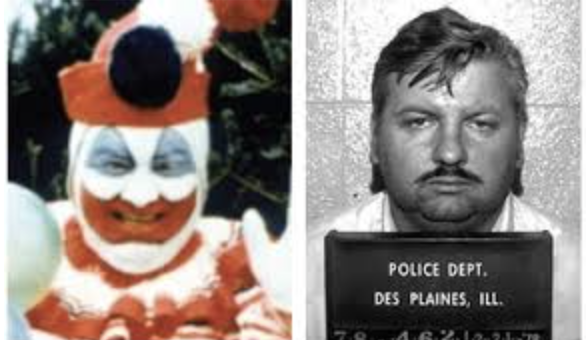
John Wayne Gacy as Pogo the Clown — and his mugshot
This psychological anonymity achieved its most sinister real-world manifestation in the mid-20th century with the case of John Wayne Gacy...
In the first picture we see the clown from the movie 'It'. It's a very famous horror movie where the clown is the main character, scaring the audience with his unusual look, emphasised by a heavy make-up. In the second picture we see John Wayne Gacy (1942–1994) who was one of America's most notorious serial killers, known as the "Killer Clown." He often was dressed as a clown as we see in the picture, to perform at neighborhood block parties and children's hospitals.
(https://upload.wikimedia.org/wikipedia/commons/thumb/b/b4/Pogo_the_Clown_by_John_Wayne_Gacy.jpg/300px-Pogo_the_Clown_by_John_Wayne_Gacy.jpg)
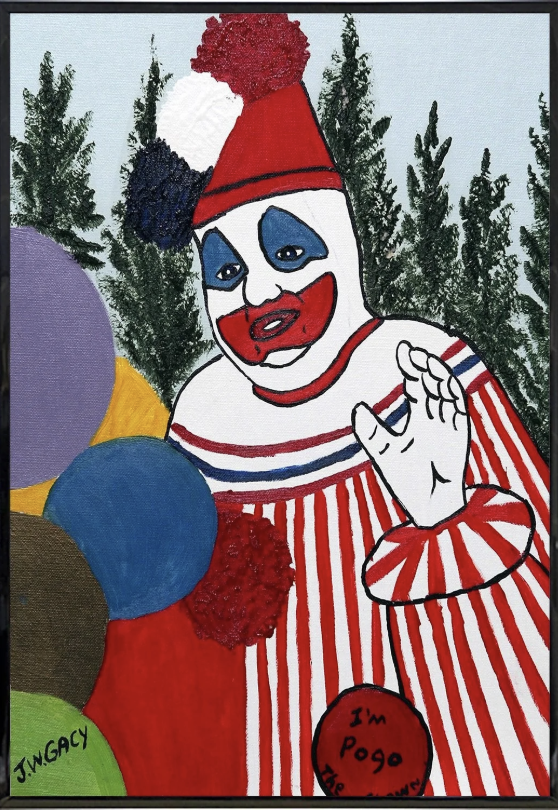
"Goodbye Pogo" - a self-portrait by John Wayne Gacy John Wayne Gacy painted this while he was on death row. It features his alter-ego, Pogo the Clown, and carries a dark, symbolic meaning regarding the killer's upcoming execution. The painting is almost a way of him saying goodbye to himself, and his clown persona before his execution.
II. The Persona of a Clown
Persona
Carl Gustav Jung
Carl Gustav Jung (1875–1961) was a preeminent Swiss psychiatrist and the founder of analytical psychology. Born on July 26, 1875, in Kesswil, Switzerland, he was the son of a pastor, Paul Jung, and grew up in a family with deep ties to both theology and medicine.
Jung pursued medical studies at the University of Basel and decided to specialize in psychiatry after being inspired by the works of Kraft-Ebbing. In 1900, he began working at the Burghölzli Mental Hospital in Zurich under Eugen Bleuler, where he gained international recognition for developing word-association tests to validate the role of the unconscious.
Persona: Definition and Origin
The word "Persona" is derived from the Latin term for the masks worn by actors in classical theater. Jung adopted this term to describe the "social mask"—the specific version of our personality that we present to the world to meet the expectations of society.
In Jungian analytical psychology, the Persona is not a sign of falsehood, but a necessary functional complex. Its primary roles include social adaptation, it allows individuals to perform various roles (professional, parental, or public) without the burden of constant emotional exposure. In addition it's also an act, a protective layer for the individual's inner life, providing an interface through which one can interact with others safely
Therefore the "tragedy" of the Persona, as Jung described it, occurs when an individual identifies too closely with their mask. When a person begins to believe they are their social status, reputation, or professional title, they lose contact with their authentic self—what Jung calls the "spirit of the depths". The danger begins by the de-individuation which means the identification with the Persona that results in a "fictitious entity" where the unique individual is swallowed by the collective expectation.
Persona and clown
The most direct connection is found in the origin of the word persona, which Jung derived from the Latin term for the masks worn by actors in classical theater. Jung defined this as the "social mask"—the façade an individual constructs to meet societal expectations and perform professional or public roles. The clown is a literal embodiment of this theater mask. By wearing distinct makeup or costuming, the clown signals that they are performing a specific role that is separate from their true inner self.
The Psychological Connection
Jungian theory insists that what we exclude from our Persona falls into the Shadow (the hidden, repressed parts of the psyche). The clown acts as a bridge between these realms.
The Return of the Repressed
The clown often behaves like the Shadow (clumsy, aggressive, hyper-emotional, or chaotic). However, because the clown is a "controlled" performance, it allows the audience and the performer to integrate their shadow.
The Ego-Clown Tension
In psychology, a "healthy" person has a flexible Persona. They can be professional at work and a fun person in their personal life. Evidently - If the human becomes the clown in real life, they lose their ability to function in society.
To summarize my point- the persona is a mask of competence, the clown is a mask of incompetence. Both are necessary for a balanced society: the persona keeps the world running, while the clown keeps the human heart from becoming too rigid.
So why do I think that we are all clowns ?
We are all clowns, but we spend most of our lives desperately trying to prove we are not. Philosophically, the clown represents the existential gap. As humans, we possess a diverse amount of ambitions: we seek love, meaning, success, validation, transcendence and many more. We naturally put immense energy into tasks that are ultimately transient. Consequently we juggle careers, relationships, and health, inevitably failing one from time to time, trapped in the unpredictable flow of life.
The Sociology of the "Everyday Clown"
In sociology, Erving Goffman's theory of Dramaturgy suggests that all social life is a theatrical performance. We have a "front stage" (where we act) and a "back stage" (where we drop the act). The tragedy of the modern human is that we have become "clowns" who have forgotten we are on the scene. We take our performances so seriously that we suffer from "burnout" which, when we caricaturize it in clowning terms, is simply a clown who has lost their sense of play.
The Distinction: Conscious vs. Unconscious Clowns
If we are all clowns, there is only one significant difference between the person on the stage and the person in the social environment: Awareness.
→The Unconscious Clown: These people believe that their Persona is 100% real. They are the most "clownish" because they are unaware of their own natural absurdity.
→The Conscious Clown: These people recognize the absurdity of existence. - They know their social mask is a temporary tool. They have achieved what Nietzsche called Amor Fati -the love of one's fate, including the stumbles.
Let's interpret clownhood as the ultimate form of honesty. By admitting we are all clowns, we stop the exhausting work of maintaining a 'perfect' Persona and try to discover and understand our authenticity. We acknowledge that life is a circus, that failure is inevitable, success can be a part of our life and can leave us anytime. The maturity comes whenever you try to learn from the bad experiences and the good ones that we are all facing, inevitably. Unconscious clowns try to control life and want to play the game with their own rules. Meanwhile the conscious clowns know the presence of a certain persona, corralled to their shadow; tries only to control the things that they can, learns to play the game with their own rules, correcting them according to the situation. In the world where we live, a persona is necessary- we need to be the 'mother' of our child, the 'boss' of our company, the 'student' in our school. Persona is not an enemy- it's a concept that gives us a social title and helps us to integrate ourselves in the social life. While I think about persona, I think about fire - for a survivor (us humans) that tries to live in the wild, fire (persona) is a crucial source. If he uses it wisely from a logical distance for heating then it is beneficial. Contrarily if he gets too close and doesn't respect a certain undefined limit, he can burn himself. That metaphor is exactly how the persona is: it's necessary, you need to have it to be able to survive in the wild (society), but if you can't define a limit between yourself and the fire-it burns you. Which leads to the fact that, you believe and define yourself only based on your status, social titles and lose your authentic human side by limiting and squeezing yourself in these titles.
The reason we are symbolically "clowns" lies in the dual nature of the human condition, while the reason we resist this identity internally is rooted in our biological and social need for status and safety.
Why do we reject the "Clown" internally ?
If the clown is a caricaturized symbol of our true, fallible nature, why do we find the idea of being a clown so repulsive or frightening?
The Threat to the "Ego-Ideal"
Psychologically, we build an Ego-Ideal—a mental image of who we "should" be (successful, attractive, respected). The clown is the Anti-Ideal, to accept the clown internally is to accept that our Ego-Ideal is a fiction.
Social Survival and "The Pecking Order"
Evolutionarily, being a clown ("a stupid/ a fool" = a failure) meant social ostracization. In a hunter-gatherer tribe, the "clumsy fellow" was a liability. We have a deep, ancestral fear that if we are seen as "clowns," we will lose our protection, our mates, and our status. Our internal resistance is a survival instinct designed to keep us looking "competent" to the tribe.
The Fear of the Uncontrollable
The clown is a symbol of Chaos. Internally, we crave Order. Admitting we are clowns means admitting we are not in control of our lives. It means acknowledging that a single slip-up can turn a "serious" person into a "laughing stock." We reject the clown because we fear the fragility of our own dignity.
We are symbolically clowns because we are the "interrupted species"—always striving, always failing. We reject it internally because we mistake dignity for survival. The professional clown is simply a human who has realized that dignity is a burden, and that there is more power in the fall than in the standing.
*Special section: The Harlequin as a Transitional Archetype
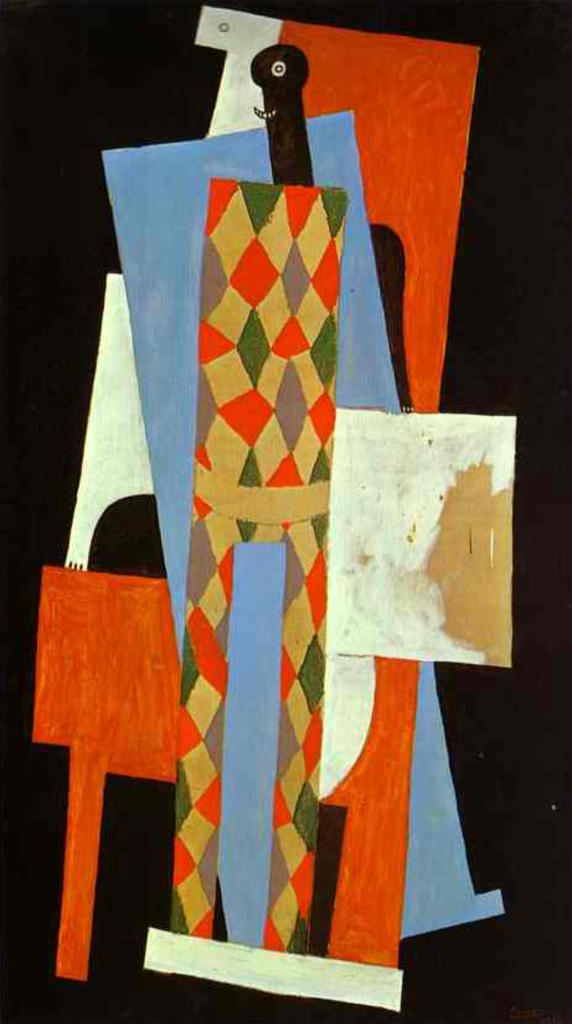
"Harlequin" by Pablo Picasso, 1915
In his 1932 analysis of Pablo Picasso, Jung explicitly identifies the Harlequin as a key symbolic figure. Jung describes Picasso's Harlequin as a "tragically ambiguous figure" who bears on his costume the "symbols of the next stage of development". The Controversy- Jung was criticized for calling Picasso "schizoid" (a personality type or condition characterized by severe emotional detachment, social isolation, and a general lack of interest in forming relationships with others) based on these paintings.
III. Thinkroom (my opinions about these topics)
-(These thoughts belong entirely to me as an individual. You have every right to agree or disagree with my perspectives. My views are subjective, and I highly recommend that you critically question everything I say for yourself. I am by no means asserting that my words represent an absolute truth or a universal standard that everyone must follow. Furthermore, what I express may not apply to everyone's unique circumstances; therefore, I kindly ask that you view these statements merely as ideas and food for thought :)))
As you might assume, 'the clown' character is a metaphor that I chose to use for describing human nature. I preferred to take the 'clown' as a character, independently to make a connection between the 'average human' vs 'the clown'.
Naturally we tend to think that we are not considered as clowns just because we don't wear extravagant make-up or some colorful costume; which makes sense, because if you asked me personally I would tell you that I am not a clown ! Because who wants to be considered a clumsy person wearing make-up and a costume that looks 'unnatural'/ 'non human'.
My point is that the 'clown' character that we tend to make fun of and see as inferior to us, is not that different from who we are.
If we put the visual aspect aside, we all have that mask intended to protect ourselves. That mask shouldn't be considered necessarily as a negative cover ; because it's human nature. We, like clowns, tend to represent ourselves in a specific type of way (for example, happy, strong, successful…) the majority of the time. This specific representation is a mask built to feel like we belong somewhere, to feel accepted and to be loved, meanwhile we try to represent the best of ourselves.
The correlation between a clown and a human is that specific mask - for instance the aim is different.
Specifically, what differentiates us from clowns is the fact that they make mistakes, appear stupid with their clumsiness and present themselves to people that way- while we don't, it's radically something that we try to escape from. They exist and are identified by the silly things they do, meanwhile we describe our value and existence by the success we make.
We human beings see those kinds of foolish-clownish behaviors, interpret them and we come up with similar conclusions; I don't want to be like that.
That's where the persona comes into action; the persona wants to represent the best of ourselves, the 'validated' one, the 'accepted' one- the competent one. I feel like when a person is terrified of appearing as a 'clown (the anti-persona)' the latter slowly becomes one; the only difference is that he spends all of his life trying to prove that he is not.
The dilemma of the human is always the same; is life that serious or not ? We tend to be in this dilemma most of the time whenever we think about something, whenever we need to make a decision or while experiencing things. Is it that deep or not ? The answer for me is yes and no; it depends on what sort of things you prioritize. Let's take an example ; I personally prioritize intellectuality. Anything about this subject is valuable, deep for me. Contrarily I don't prioritize any negative comment that has been made with a bad intention, it's not that deep…
I think that- is life that deep or not- is not a good way of questioning the experiences that you currently are having. The answer to that question will never be specific or objective- it will totally depend on your life-style and personal perception. Life is deep and not, but more importantly life is so complex that it cannot be limited or described as 'deep' and 'not deep'.
However if you really want an answer to that question, ask yourself- because the answer cannot be taught or proved by another. You decide to make your life meaningful- deep or not, there is no such thing as 'a collective theory of life' that makes you a list and proves everyone in this world how life is, how it should be interpreted and how we should live…So you need internally to ask and see how you want to shape your life and how you want life to shape you in return.
In general we tend to live our lives through other people's eyes; assuming or being confronted with the idea they had about us. Your social status, your image is a part of you but is never truly understood by the other person; you can't truly be described and defined by your job, your family, your friends. These things might give an idea about your potential personality - it's never meant to truly describe you. You are a paradoxical and complex being; who is independent and different from everyone, who is dependent and cooperative to anyone.
Ultimately the core is not the costume or the makeup; the whole point is the fact that we are scared of the other person's ideas of our being. That's exactly the reason why we become clowns- because we constantly conceal behind a mask that people would love and accept. As time goes by we truly believe that we are the mask that we built up, starting to live a life dependent on them. So you don't wear the mask anymore, you don't use it: it uses you.
We are scared of his vision, of 'their' vision, we are scared to make mistakes, to be clumsy, to be understood or seen as the contrarian one. To act 'stupid' in front of individuals who do not behave in such a manner. That's the whole dilemma; we are building an 'ideal person', detached from pure reality. At the end, it's not authentically us ; it's a potential version of us, it's how we want us people to see- it's who we want to be while we are not.
Seeing is subjective -
Visually seeing is one of our senses, it gives us the possibility to see the world through our eyes- we also hear a bunch of metaphors about the event of 'seeing' and looking. We say 'eyes are the mirror of the soul' in English. In Turkish there is this beautiful saying that I love ; whenever someone compliments us, we tend to say "O senin güzel bakan gözlerinin güzelliği". In English it translates to "That's just your lovely way of looking".
However we tend to feel like 'looking/seeing' is objective- if we both look at a table full of flowers, we both see the same things.
So yes theoretically seeing is objective but it's also very subjective; because I believe that observing something is more than physically seeing it- a part of seeing something is understanding and interpreting that thing. You see something whenever you focus on that specific thing, after seeing that you understand it and interpret it in your own way (according to your beliefs, your mentality, your perception, your prejudice…).
That's also the core of art ; we might look at the same painting or monument, see the exact same colors, figures but feel and understand/interpret/ think differently. Because we don't only visually see- seeing physically is not the main subject here. The whole value of being able to see, which is a very fascinating possibility as a whole, is to be able to understand what you are looking at.
Collecting way of seeing things
There is a certain collective way of seeing things. Even though we, as human beings, are one of a kind, we are living in a society and many resemble essences no matter what. Two mothers from totally different backgrounds, nationalities, lifestyles might feel both a certain way about motherhood. Citizens of a specific country; share the same historical backgrounds, an idea of the nation as a community, even though they are all separate individuals. Living in a society makes us 'learn' how to look at things, it's not always purely personal and independent.
Let's take the example of flowers again- we all do think in general that they are beautiful. When we are children we see people gifting them to people they love; we see that the person is feeling happy receiving it. Collectively we also give flowers to people we appreciate- so it must be a collective construct that we might have internalized. I can even mention the fact that the culture, the religion and the familial aspects play a big role in that; as an owner of 3 black cats I know that the opinions about them are culturally divergent ; In many Western cultures, they are associated with bad luck, witchcraft, and Halloween, often stemming from medieval superstitions. Conversely, in many other cultures—particularly in Japan, Scotland, and the UK—black cats are considered symbols of prosperity, protection, and good fortune.
This collective conditioning perfectly mirrors Martin Heidegger's concept of 'Das Man' (the 'They'). We rarely see the world with absolute authenticity; instead, we perceive it through the prefabricated filters dictated by the anonymous collective, transforming us into unconscious actors in a social circus. Society teaches us that flowers are beautiful, black cats are "ominous"; we see the world not through our own eyes, but through the eyes of "Everyone".
I feel that the mask, the persona is not the enemy when you are conscious and have it in harmony with your reality; the foe is a person who keeps fighting with himself- it's the unwanted situation he is in, the unwanted mentality he has and does nothing but hate himself without even getting in action to change things. From time to time, we tend to be harsh with ourselves, without accepting the 'fool' situation we put ourselves in. To me, as long as an action is not meant to hurt yourself or someone intentionally, or the move is not made in bad intentions, or unconsciously; being the clown sometimes is okay.
I am okay with it because I am aware that it's a part of my nature to fail, to fall down, especially if I use that situation to grow myself: then I see it as a win. I am okay with it, because I prefer to choose myself, to learn from my experiences instead of being in a constant fight with the only person that I will spend my lifetime with - myself.